
Artikel: The History of Ear Cuffs: From Ancient Ear Ornaments to Modern Jewellery

The History of Ear Cuffs: From Ancient Ear Ornaments to Modern Jewellery
Ear cuffs have become a familiar part of contemporary jewellery: a way to decorate the ear without relying on a conventional lobe piercing. But the idea behind them is far older than the modern term ear cuff.
Across different periods and cultures, jewellery makers have designed ornaments that follow, frame, hook around or cover larger areas of the ear. The exact construction has changed dramatically over time, so it would be misleading to call every historical ear ornament an ear cuff in the modern sense. Still, these objects reveal a surprisingly long history of treating the whole ear as a space for jewellery.
What Is an Ear Cuff?
Today, an ear cuff generally refers to jewellery worn around the outer ear without requiring a piercing at the point where it sits. Modern designs range from small metal bands to sculptural pieces that trace the shape of the ear.
Unlike a conventional earring, an ear cuff does not have to hang from the earlobe. Its position is determined by the shape of the ear and the construction of the jewellery itself. This simple difference opened up an entirely different approach to ear styling.
The Story Starts Before the Modern Ear Cuff
There is no neat archaeological moment when somebody invented the ear cuff. Jewellery history is rarely that cooperative.
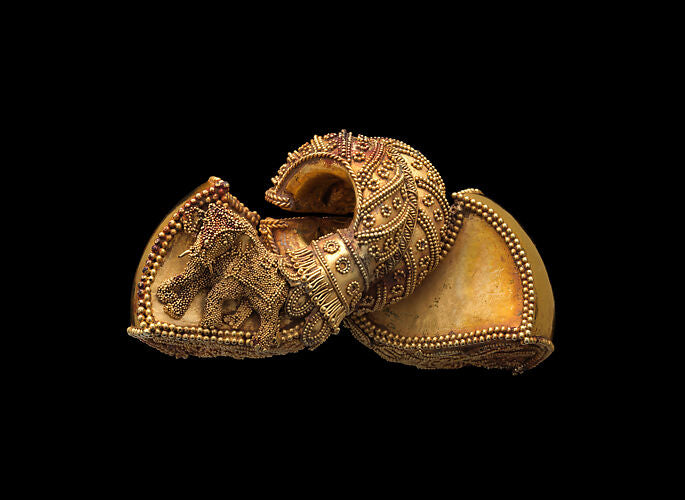
What we can trace instead is a much older tradition of elaborate ear ornaments. Museum collections contain historic jewellery designed to extend beyond a simple earlobe ornament, sometimes surrounding or covering substantial parts of the ear. These pieces were not necessarily worn in the same way as a modern cuff, but they demonstrate that decorating the ear as an architectural form is not a recent idea.
This distinction matters. Claims that the modern ear cuff was directly invented thousands of years ago often collapse very different jewellery traditions into one convenient story. The historical picture is more interesting than that.
India and the Karn Phul Tradition
One of the most important historical references in discussions of ear-covering jewellery comes from India.
The term karn phul (also written karanphul) literally refers to an “ear flower.” Historic examples can be extraordinarily elaborate, combining floral forms, precious stones and structures that spread decoration across the ear rather than limiting it to a small point on the lobe.
Indian jewellery traditions developed many regional forms of ear ornament, often involving multiple components, chains, supports or attachments. They should not simply be relabelled as modern ear cuffs, but visually and conceptually they show something familiar: the ear itself becoming part of the composition.
That idea remains central to contemporary ear-cuff design.
From Ear Ornament to Fashion Jewellery
By the twentieth century, Western fashion jewellery increasingly experimented with ornaments that climbed upward from the lobe or followed the contour of the ear.
Costume-jewellery designers helped turn the ear into a more dramatic design surface. Mid-century pieces sometimes used clips, screws, wires or multiple points of support to create the impression of jewellery spreading across the ear. These mechanisms differ from the simple open cuff familiar today, but the visual language was moving in the same direction.
Instead of asking, “What can we hang from the lobe?” designers could ask, “What can we do with the entire ear?”
The Ear Cuff and Alternative Fashion
During the later twentieth century, ear jewellery became increasingly connected with subculture and self-expression. Punk, rock and alternative fashion embraced multiple piercings, chains, safety pins and unconventional placements.
Ear cuffs fitted naturally into this visual world because they could create the appearance of a more heavily styled ear without requiring another piercing. The cuff also made asymmetric styling easy: one ear could carry a strong metal detail while the other remained almost bare.
This period helped shift ear jewellery away from the expectation that both ears should simply wear a matching pair.
How the Modern Ear Cuff Evolved
Contemporary ear cuffs are usually much simpler mechanically than many historical ear ornaments. A small opening allows the piece to pass over a narrower part of the ear before it is positioned where the ear’s natural structure can hold it securely.
That simplicity is part of the appeal. No piercing is required, and a single piece can change the architecture of an entire ear stack.
Modern jewellery designers have pushed the format in opposite directions. Some cuffs are almost invisible: a clean ring of metal following the ear. Others are deliberately sculptural, using the cartilage and contours of the ear as part of the design.
Why Ear Cuffs Feel Modern Even When the Idea Is Old
The modern ear cuff sits at an unusual intersection. Its underlying idea, decorating more than the earlobe, has deep historical precedents. Its current form, however, belongs very much to contemporary jewellery.
It suits a culture in which jewellery is increasingly modular. People mix metals, wear single earrings, build asymmetric ear stacks and change combinations from day to day. A piercing is permanent; an ear cuff can be added, moved or removed in seconds.
That flexibility has helped transform the cuff from an alternative-fashion accessory into a mainstream jewellery category.
The Ear as Part of the Design
Perhaps the most interesting legacy of ear-cuff history is not a particular shape or period. It is the idea that jewellery does not have to treat the body merely as somewhere to hang an object.
The curve of the helix, the shape of the concha and the structure of the outer ear can all influence how a piece looks and stays in position. In good ear-cuff design, the anatomy of the ear is part of the jewellery.
That principle connects elaborate historical ear ornaments with the cleanest contemporary cuffs, even when their construction and cultural meanings are completely different.
90Ninety’s and the Contemporary Ear Cuff
At 90Ninety’s, the ear cuff is approached as jewellery designed around the structure of the ear rather than as a substitute for a pierced earring.
Our cuffs are generally worn around the concha area, where the contours of the ear help hold the piece in position. The goal is not to squeeze the ear tightly. Instead, the form of the cuff and the anatomy of the ear work together to create a secure fit.
This opens up a different way to build an ear look: minimal or sculptural, single or layered, without making another piercing the starting point.
The ear cuff may have a complicated family tree, but that is exactly what makes it interesting. Across centuries, jewellery has repeatedly returned to the same basic possibility: the whole ear can be part of the design.
Frequently Asked Questions
When were ear cuffs invented?
There is no single confirmed invention date for the modern ear cuff. Historic cultures produced elaborate ear ornaments long before the contemporary cuff existed, while twentieth-century jewellery designers developed increasingly ear-covering and contour-following forms. The modern non-pierced cuff evolved from this broader history rather than appearing at one identifiable moment.
Did ear cuffs originate in ancient India?
India has an important and exceptionally rich history of elaborate ear jewellery, including karn phul forms. However, it is more accurate to describe these as historical relatives or precedents of ear-covering jewellery rather than claiming that every modern ear cuff directly descends from one ancient Indian design.
Do ear cuffs require pierced ears?
No. A modern ear cuff is specifically designed to be worn on the outer ear without a piercing at its wearing position.
Why are ear cuffs popular today?
They allow people to experiment with placement, asymmetry and layered ear styling without committing to additional piercings. They can also use areas of the ear that conventional lobe earrings do not.